
Commercial EV Charging in Davis
Practical EV charging plans for Davis office, retail, research, and mixed-use properties, built around the people who actually park there.
Davis EV Charging Strategy
Davis has spent years planning for cleaner transportation. For commercial property owners, the useful question is how charging fits your specific site, budget, and tenants.
Davis is a city where transportation choices get a lot of attention. It was the first U.S. city to install bicycle lanes, it has set a goal of carbon neutrality by 2040, and it is home to UC Davis and its Institute of Transportation Studies, one of the best-known university research centers for sustainable transportation and electric vehicles. That context shapes what tenants, employees, and visitors expect when they pull into a commercial parking lot here.
Clear Blue Commercial helps Davis owners treat EV charging as part of Davis commercial property management rather than a one-time equipment purchase. We look at who uses the property, what the electrical system can support, which PG&E and Valley Clean Energy programs may apply, and how charging fits the property’s longer-term capital and sustainability plans.
Start Here
Five Questions for Davis Owners
- ✓ Who parks here, and for how long: employees, customers, researchers, or fleets?
- ✓ How much spare capacity does the electrical service have today?
- ✓ Is the property’s parking on site, shared, or mostly downtown public parking?
- ✓ Which PG&E programs or rates fit the project?
- ✓ Would a CALGreen trigger, such as an addition or electrical upgrade, require EV work anyway?
The Short Version
What Davis Owners Should Know Before Adding EV Charging
In Davis, the electricity on the wire is supplied by Valley Clean Energy for most customers, but PG&E still owns the poles, transformers, and service connections. That split matters when you plan a charging project. Add the City of Davis permit process, current CALGreen requirements, and the realities of a compact, bike-friendly downtown, and the best plan usually starts with the property’s parking patterns and electrical capacity, not a product catalog.
Key Takeaways
- ✓ PG&E handles the grid side of any Davis charging project: service upgrades, interconnection, and EV programs and rates.
- ✓ Valley Clean Energy is the local electricity provider for Davis, Woodland, Winters, and unincorporated Yolo County.
- ✓ The City of Davis requires a site plan, electrical plan, load calculations, and accessible charging spaces for commercial EV permits.
- ✓ Charging demand at a Davis property depends heavily on how long people stay and whether they arrive by car at all.
- ✓ Off-grid solar charging can make sense where the electrical service is tight or trenching would be expensive.
Why Read This
EV charging touches parking, electrical infrastructure, leasing, and operating budgets at the same time. A decision made quickly to answer one tenant’s request can lock in a layout or electrical design that limits the property for years.
This page walks through the Davis-specific factors that change the plan, the steps we use to scope a project, and how to fold charging into capital planning so each phase builds on the last.
Local Context
Why Davis Is Its Own EV Charging Market
Davis is a city of about 66,000 residents, according to the U.S. Census Bureau’s 2025 estimate, but its daily population feels larger because of UC Davis. Commercial demand clusters around the downtown core, the corridors near campus, neighborhood shopping centers, and office and research space that serves university-connected companies. Each of these behaves differently when it comes to charging.
Transportation is the largest source of greenhouse gas emissions in Davis. The City reports that it accounts for 79 percent of community emissions in its most recent inventory, which is why the City has made EV charging part of its climate work. Davis led Electrify Yolo, a regional effort funded largely through a SACOG Green Region grant to add public Level 2 and DC fast charging, mobile solar chargers, and a fleet electric vehicle. Sites the City approved for public charging included the City Hall parking lot, the E Street parking lot, the Amtrak lot, the Olive Drive lot, and a location near Central Park.
For private owners, public charging downtown is both a convenience and a reality check. Some visitors will already have places to charge, and some will arrive on a bike. That does not make on-site charging less useful. It means the right number of ports, and the right charging speed, should come from how your property is used rather than a general assumption about EV adoption.
The City has also been an early mover on building standards. Its 2019 non-residential energy reach code added EV charging requirements beyond the state baseline for commercial and high-rise residential buildings. Requirements are updated as codes change, so owners should confirm what currently applies with the City of Davis Building Division before design begins.
Davis at a Glance
Local Facts That Shape a Project
- ✓ Grid owner and utility programs: PG&E
- ✓ Electricity supplier for most customers: Valley Clean Energy
- ✓ City climate goal: carbon neutrality by 2040
- ✓ Permits: City of Davis Community Development commercial EV checklist
- ✓ Research presence: UC Davis Institute of Transportation Studies
Know Your Users
Who Charges at Davis Commercial Properties
The same parking lot can serve very different drivers. Matching charging speed to how long people stay is the single most useful planning decision.
Office and Research Tenants
Long stays, predictable schedules.
Employees at office, lab, and research space often park for most of the day. Level 2 charging, sometimes with load management to share capacity across more ports, usually fits this pattern well.
Retail and Restaurant Visitors
Short stays, unpredictable arrivals.
Shoppers and diners may stay an hour or less. A small number of well-placed ports, clearly signed and easy to find, often serve them better than a large Level 2 bank.
Mixed-Use and Downtown Buildings
Tight lots, shared demand.
Downtown properties often have limited on-site parking, so every space matters. Charging may need to serve residents overnight and commercial users by day, which makes scheduling and access control part of the plan.
Fleets and Service Vehicles
Demand tied to routes.
Delivery vans, maintenance trucks, and university-adjacent service vehicles need charging matched to when they return and how far they travel. Fleet needs can grow quickly once a tenant commits to electrification.
Medical and Professional Offices
A mix of staff and patients.
Staff stay all day while patients and clients come and go. Separating staff charging from visitor charging, or using time limits, can keep both groups served.
Owners and Property Teams
Operations count too.
Someone has to manage access, pricing, maintenance, and support calls. Deciding who owns those tasks before installation avoids frustrated tenants later.
Our companion article, EV Charging Demand at Davis Commercial Properties, explains how to estimate demand for each of these groups.
Utilities and Programs
PG&E, Valley Clean Energy, and What Each Means for Your Project
Davis sits in Yolo County, so it is in PG&E territory, not SMUD’s. Valley Clean Energy, a locally governed, not-for-profit community choice electricity provider formed by the City of Davis and Yolo County, supplies electricity to most Davis customers. PG&E still delivers that power, maintains the lines, reads the meters, and handles billing. For a charging project, that means service upgrades, transformer questions, and interconnection all run through PG&E.
PG&E offers several commercial EV options, and their status changes. At the time of writing, PG&E reports that its EV Fleet program is fully subscribed and no longer accepting applications. PG&E also offers Schedule BEV, an optional rate for separately metered commercial EV charging that replaces traditional demand charges with a monthly kilowatt subscription. PG&E’s EV Advisory Services, which provides free guidance to medium and heavy-duty fleet operators, is scheduled to end its current version at the end of 2026, according to PG&E’s own program updates. Its Multifamily Housing and Small Business EV Charger program has reached full subscription and is no longer accepting applications.
Valley Clean Energy lists EV resources, commercial rate options, and a commercial vehicle-to-everything (V2X) charging offering on its website. Because program terms and availability change, owners should confirm current details directly with PG&E and Valley Clean Energy before building a budget around any incentive.
One more point worth noting: the federal Section 30C tax credit for EV charging equipment applied only to property placed in service through June 30, 2026, according to the U.S. Department of Energy. It should not be part of a new Davis project’s financial model.
Know which part of the project belongs to PG&E, which belongs to the City, and which belongs to you. That is where most schedule surprises come from.
Codes and Permits
City of Davis Permitting and CALGreen
The City of Davis Community Development Department publishes a checklist for commercial EV charging permits. It asks for a building permit application, a site plan showing parking, circulation, and the locations of new and existing chargers and electrical equipment, and an electrical plan with a single-line diagram, load calculations covering existing and new loads, and a panel schedule. Both plans must show compliance with accessibility requirements.
Accessibility is often the item owners underestimate. The City’s checklist sets a minimum number of accessible charging stations based on the total at the facility. For a site with one to four chargers, at least one must be van accessible. Larger installations require additional accessible and ambulatory spaces. Those spaces take up more room and often need to sit near accessible routes, which affects layout and cost.
California’s CALGreen code adds another layer. New nonresidential construction must include EV capable spaces and installed charging based on the total number of parking spaces. Some alterations can trigger requirements too, including projects that increase electrical service to a panel or add solar over existing parking. New warehouses, grocery and retail stores, offices, and manufacturing buildings with planned loading spaces also face medium and heavy-duty charging readiness requirements. If you are already planning one of these projects, it is usually more efficient to design charging into it from the start.
Permit Prep
What the City Expects to See
- ✓ Site plan with existing and proposed charger locations
- ✓ Electrical plan with single-line diagram
- ✓ Existing plus new load calculations and panel schedule
- ✓ Accessible and van-accessible charging spaces
- ✓ Manufacturer installation instructions
Grid-Connected or Off-Grid
Where Off-Grid Solar Charging Fits in Davis
Grid-connected charging works well when the building has spare capacity and the chargers can sit close to existing electrical equipment. In older Davis buildings, or on lots where the best charging spaces are far from the service panel, the cost of new service, trenching, and paving repair can grow faster than the cost of the chargers themselves.
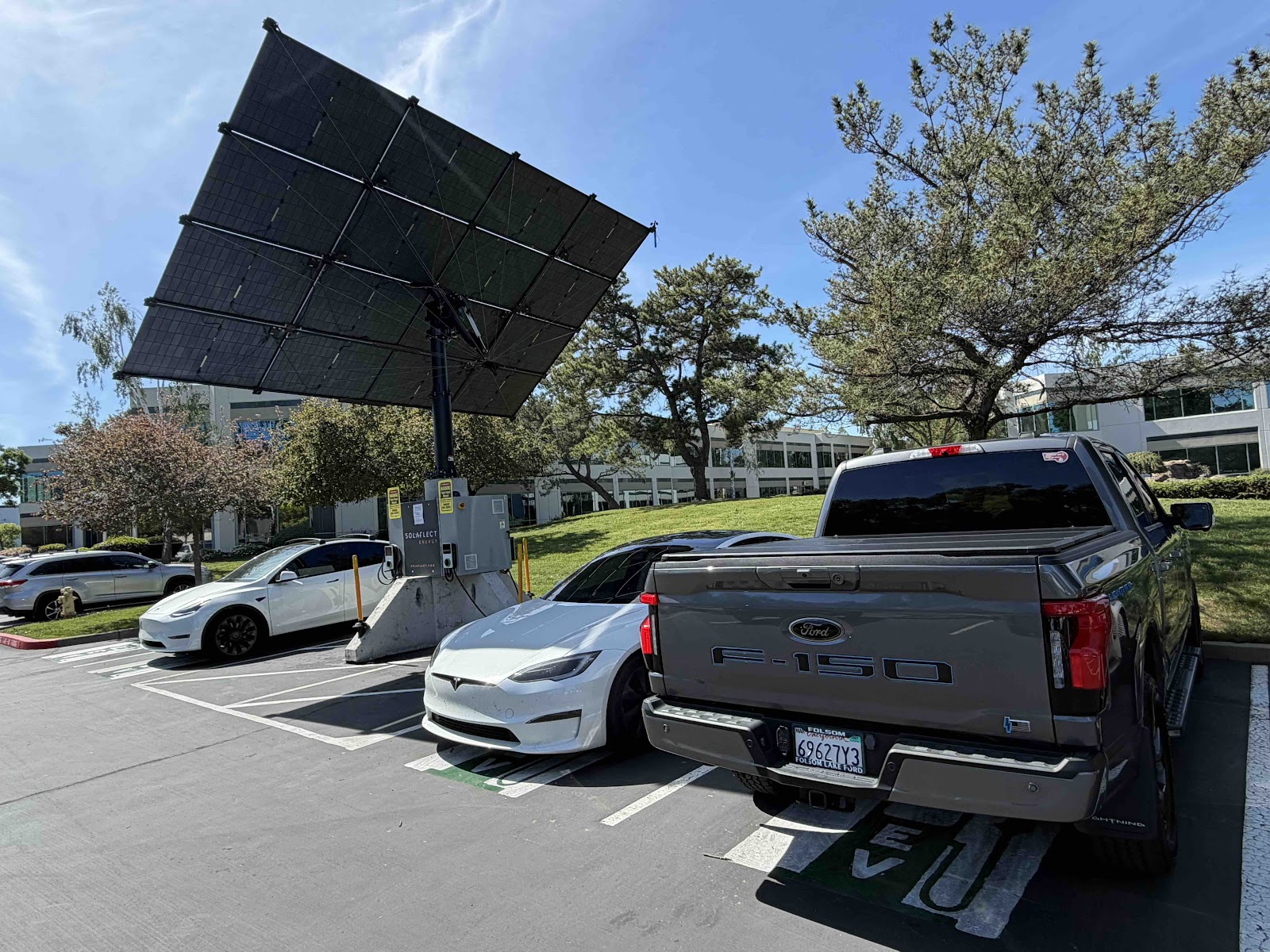
Off-grid solar EV charging takes a different approach. A self-contained solar unit generates its own power with no grid connection, which eliminates PG&E service upgrades and long trenching runs. Davis gets plenty of sun for much of the year, and many suburban office and retail lots have open parking areas that suit a freestanding unit. Clear Blue Commercial offers a solar EV charging solution and can compare it side by side with conventional options.
Off-grid charging is not the right answer for every site. Shading from Davis’s mature street trees, the number of vehicles that need charging each day, and the charging speed tenants expect all matter. Our guide to grid-connected vs. off-grid commercial EV charging walks through the tradeoffs in more detail.
The goal is the lowest total cost for the charging your property actually needs, not the most impressive installation.
How We Approach It
A Phased Path to EV Charging in Davis
Clear Blue Commercial helps owners move from a tenant request to a working, maintained charging program without overbuilding.
01
Map How the Property Is Used
Review parking counts, dwell times, tenant mix, and any fleet plans. Talk with tenants about current and expected EV use so the plan reflects real demand.
02
Check Capacity and Layout
Review the electrical service, panels, and distances to likely charging spaces. Identify where load management, off-grid units, or a PG&E service upgrade make sense.
03
Line Up Programs, Rates, and Permits
Confirm current PG&E and Valley Clean Energy options, model operating costs under the right rate, and prepare the City of Davis permit package, including accessible spaces.
04
Install, Operate, and Expand
Coordinate installation around tenants, set up access, billing, and maintenance, and leave conduit and capacity in place for the next phase.
Think Long Term
Putting EV Charging Into Your Davis Capital Plan
The least expensive time to prepare for charging is when the ground is already open or the electrical room is already being reworked. Parking lot resurfacing, panel replacements, rooftop or carport solar, and major tenant improvements are all natural moments to add conduit or reserve capacity, even if chargers come later.
Phasing also protects the budget. Many Davis properties can start with a small number of ports where demand is clear, measure actual use for a year, and expand once the data supports it. Choosing equipment and software that can grow, and designing the first phase with the second in mind, keeps that expansion simple.
Charging also connects to the property’s broader performance. It affects electrical load, utility costs, tenant satisfaction, and how the building compares with newer space in a market where many tenants care about sustainability. Our sustainable commercial property management in Davis page covers how charging fits alongside energy, water, and operations improvements. For a closer look at the electrical side, see how to evaluate electrical capacity before installing EV charging.
Good Moments to Plan
Pair EV Work With
- ✓ Parking lot resurfacing or restriping
- ✓ Panel, switchgear, or service upgrades
- ✓ Solar carports or rooftop solar
- ✓ Additions or alterations that trigger CALGreen
- ✓ A new lease with a tenant that runs vehicles
Owner Questions
Davis Commercial EV Charging FAQs
Which utility serves commercial properties in Davis?
Davis is in PG&E’s service territory. Most customers receive their electricity supply from Valley Clean Energy, the local community choice provider, while PG&E delivers the power, maintains the grid, and handles billing and service connections. Any service upgrade for EV charging goes through PG&E.
Are there PG&E programs for commercial EV charging in Davis?
At the time of writing, PG&E offers Schedule BEV, an optional subscription-based rate for separately metered commercial charging. Several programs have closed or are winding down, including the EV Fleet program, which is fully subscribed, and the Multifamily Housing and Small Business EV Charger program, which reached full subscription. Confirm current availability with PG&E before planning around a program.
Does Valley Clean Energy offer anything for commercial EV charging?
Valley Clean Energy lists EV resources, commercial rate options, and a commercial vehicle-to-everything (V2X) charging offering on its website. Details and eligibility change, so contact Valley Clean Energy for current terms.
What does the City of Davis require for a commercial EV charging permit?
The City’s commercial EV charging checklist calls for a building permit application, a site plan, an electrical plan with a single-line diagram, load calculations, a panel schedule, manufacturer instructions, and accessible charging spaces based on the number of chargers. Check with the City’s Building Division for the current checklist and any local code amendments.
Do I have to add EV charging if I renovate my Davis property?
It depends on the scope. Under CALGreen, new nonresidential construction must include EV capable spaces and installed chargers, and certain additions and alterations, such as those that increase electrical service to a panel, can trigger requirements. Davis has also adopted local reach code provisions in the past. Your design team and the City can confirm what applies.
Is the federal EV charger tax credit still available?
The federal Section 30C credit applied to qualifying charging property placed in service through June 30, 2026, according to the U.S. Department of Energy’s Alternative Fuels Data Center. Owners should review current federal, state, and utility incentives with their tax advisor and program administrators.
How many chargers does a Davis office or retail property need?
There is no single answer. Start with how many people park, how long they stay, how many already drive EVs, and whether tenants plan fleet changes. Many owners begin with a modest first phase, measure use, and expand with infrastructure that was planned for growth from the start.
How does Clear Blue Commercial help with EV charging?
We treat charging as part of property management and capital planning: understanding tenant needs, assessing the site, comparing grid-connected and off-grid solar options, reviewing utility programs and rates, coordinating permits and vendors, and setting up operations and maintenance.
Keep Learning
Continue Exploring
More resources for Davis and greater Sacramento property owners.
Commercial EV Charging in Sacramento
Our regional guide to planning commercial EV charging across the Sacramento area.
Davis Commercial Property Management
Hands-on management for Davis office, retail, and mixed-use properties.
Sustainable Commercial Property Management in Davis
Energy, water, and operations improvements that support long-term value.
EV Charging Demand at Davis Commercial Properties
How to estimate charging needs for tenants, visitors, and fleets.
Commercial EV Charging Infrastructure
Planning EV charging as part of a long-term property strategy in California.
Plan EV Charging That Fits Your Davis Property
Whether a tenant has asked for charging, a renovation may trigger code requirements, or you simply want to know your options, the first step is understanding what your property can support today.
Clear Blue Commercial’s complimentary Sustainable Property ROI Audit Kit helps owners review infrastructure, operating costs, and capital needs together, so EV charging becomes part of a plan rather than a one-off project.