
Most EV charging mistakes start with a number picked too early. Before a Davis owner decides how many chargers to install, it helps to know who will actually plug in, when, and for how long.
Key Takeaways
- ✓ Estimate demand separately for tenants and employees, visitors, and fleets, because each group charges differently.
- ✓ Dwell time, not EV adoption headlines, is the best guide to charging speed and port count.
- ✓ Davis has public charging downtown and a strong bike culture, so on-site demand varies more by property than in many cities.
- ✓ CALGreen sets a minimum for new construction and some alterations, but it is a floor, not a demand forecast.
- ✓ A measured first phase with conduit and capacity for later phases usually beats a large one-time build.
When a tenant asks for EV charging, the natural reaction is to ask a vendor how many chargers to buy. A better first question is how many vehicles will need a charge on a typical day, and how much time each one will be parked. In Davis, the answers can vary widely from one property to the next, even within a few blocks.
This article walks through a practical way to estimate charging demand by user type. It supports our page on commercial EV charging in Davis, which covers utilities, permits, and capital planning in more detail.
Why Demand Looks Different in Davis
Davis is a university city with about 66,000 residents, according to the U.S. Census Bureau’s 2025 estimate, and a daily rhythm shaped by UC Davis. It was the first U.S. city to install bicycle lanes, and many people downtown arrive on foot or by bike. At the same time, the City has made EV charging part of its climate work, including the regional Electrify Yolo effort to add public chargers at City-owned lots.
For a property owner, that creates an unusual mix. Some of your visitors may never need to charge on site. Others may expect it, especially at office and research space where employees drive in from elsewhere in Yolo County or the Sacramento region. The result is that general EV adoption numbers are a weak guide. Your own parking patterns are a much better one.
Demand is a property question first. The parking lot already holds most of the answers.
Step One: Split Users Into Three Groups
Most Davis commercial properties serve some combination of three groups. Estimating each one separately keeps the math honest.
Tenants and Employees
These are the people who park for most of the day. Their demand is the most predictable and usually the easiest to serve, because a long dwell time means slower Level 2 charging can deliver what most drivers need.
- Count the number of employees who regularly drive to the property, not the total headcount.
- Ask tenants how many of those employees drive an EV or plan to in the next few years.
- Ask whether tenants would value assigned charging, shared charging, or a rotation policy.
Shared ports with simple rules, such as moving the car after a set period, can serve more drivers than one port per EV. Load management, which shares available electrical capacity across several chargers, can also stretch a limited electrical service further.
Customers and Visitors
Visitor demand is harder to predict. A shopper at a neighborhood center, a diner downtown, or a patient at a medical office may stay less than an hour. A few Level 2 ports provide only a modest top-up in that time, so the value is partly convenience and partly signal: it tells visitors the property is ready for them.
- Look at typical visit lengths. Shorter visits favor fewer, more visible ports or faster charging if capacity allows.
- Note how close the property is to public charging, such as City-owned downtown lots.
- Decide early whether visitor charging will be free, paid, or time-limited.
Fleets and Service Vehicles
Fleet demand is the most concentrated and the easiest to underestimate. A tenant with delivery vans, service trucks, or shuttles may need several vehicles charged overnight, every night, on a schedule set by routes rather than convenience.
- Ask tenants about current vehicles, replacement timelines, and daily mileage.
- Confirm when vehicles return and leave, since overnight charging spreads load across more hours.
- Check whether PG&E fleet programs or rates fit. At the time of writing, PG&E reports its EV Fleet program is fully subscribed and closed to new applications, but its Schedule BEV rate offers a subscription-based option for separately metered commercial charging. Confirm current terms with PG&E.
Step Two: Turn Dwell Time Into Charging Speed
Once you know who parks and for how long, the charging type becomes clearer. Long stays generally fit Level 2. Short stays and tight fleet turnarounds may justify DC fast charging, but that requires much more electrical capacity and usually more utility coordination.
CALGreen’s alternative power allocation method uses 6.6 kVA per Level 2 charger as a planning figure, which is a helpful way to translate port counts into electrical load. If ten Level 2 ports would need roughly 66 kVA at full output, it becomes easier to see why load management or a phased approach matters on a property with limited spare capacity. Our article on evaluating electrical capacity before installing EV charging covers that step.
Step Three: Check the Code Minimum
California’s CALGreen code requires EV capable spaces and installed chargers for new nonresidential construction, based on total parking spaces, and certain additions and alterations can trigger requirements too. New warehouses, offices, retail and grocery stores, and manufacturing buildings with planned loading spaces must also plan for future medium and heavy-duty charging.
Treat those requirements as a minimum. A Davis research office with many EV-driving employees may want more than code requires, while a small retail center may find the code minimum covers current demand comfortably. The City of Davis commercial EV checklist also sets accessible charging space requirements based on the number of chargers, which affects layout from the very first port.
Step Four: Plan the First Phase and the Next One
With demand estimates for each group, most owners can size a first phase that meets clear current needs. The key is to design for the second phase at the same time:
- Install conduit to additional spaces while trenching is open.
- Size panels and switchgear with expected growth in mind, where the budget allows.
- Choose charging software that reports actual use, so expansion decisions are based on data.
- Revisit demand once a year with tenants, especially at lease renewals.
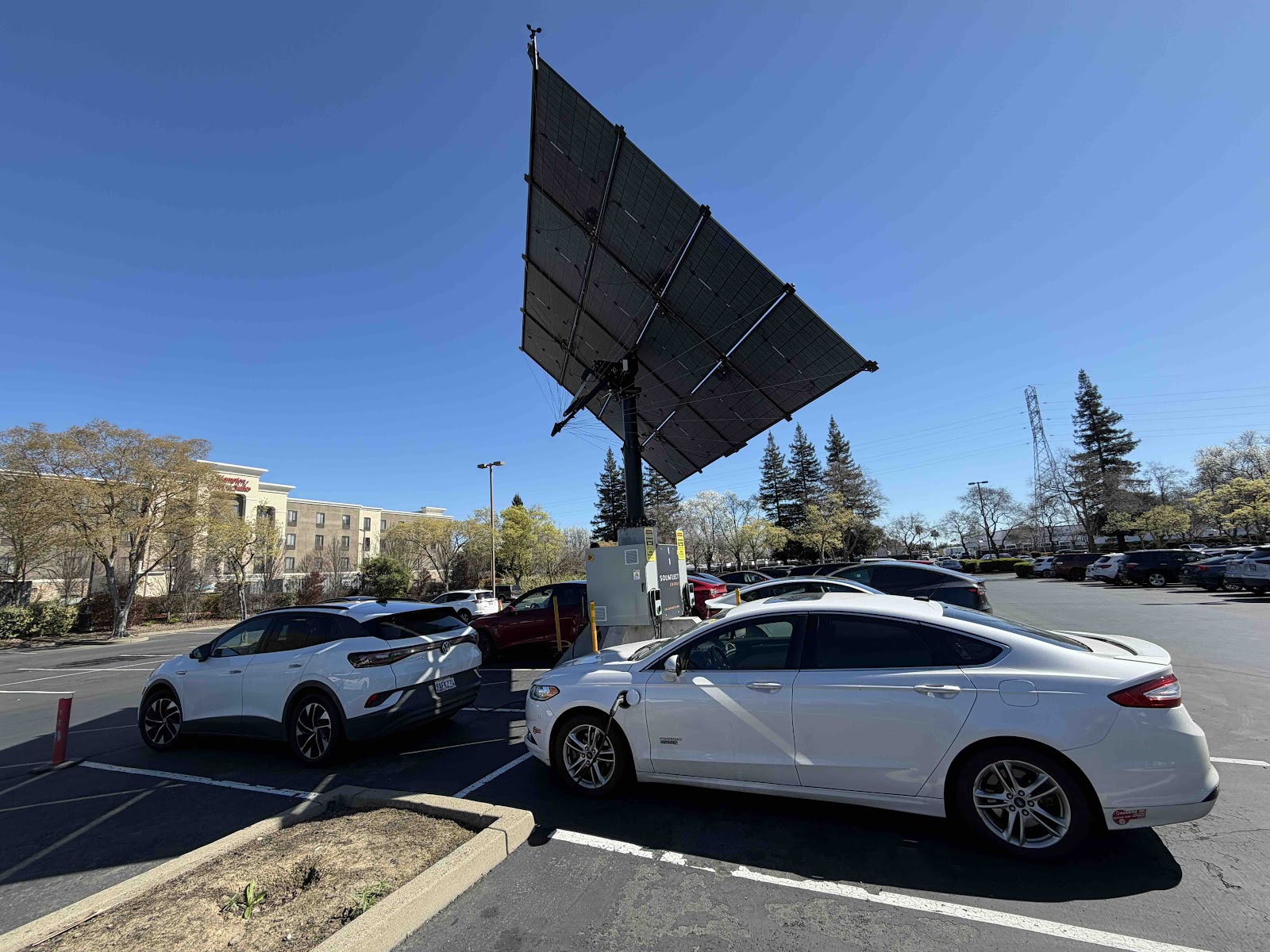
Where the electrical service is tight or the best charging spaces are far from the building, an off-grid solar unit can add capacity without a PG&E service upgrade. Our comparison of grid-connected and off-grid commercial EV charging explains when that makes sense.
Connecting Demand to the Bigger Picture
Charging demand is one part of how a Davis property performs. It affects tenant satisfaction, electrical load, and operating costs, and it fits naturally alongside other improvements. Our December articles on managing commercial property in a university-driven market and cutting water and energy costs without major projects cover those connections. If you own property in more than one market, our guide to how East Bay owners compare local managers may be useful too.
Davis EV Charging Demand FAQs
How do I estimate EV charging demand for my Davis property?
Split users into tenants and employees, visitors, and fleets. For each group, estimate how many vehicles park on a typical day, how many are electric now or soon will be, and how long they stay. Dwell time points you to the right charging speed, and the number of vehicles points you to the number of ports.
Should I install one charger per EV driver?
Not necessarily. For employees who park all day, shared ports with clear rules, or load management that divides capacity across several chargers, can serve more drivers with less electrical infrastructure.
Does public charging downtown reduce the need for on-site chargers?
It can for short visits, but employees and fleets generally need charging where they park. Note nearby public options when estimating visitor demand, then focus on-site charging on the users who depend on it most.
Is the CALGreen requirement enough?
CALGreen sets a minimum for new construction and some alterations. It is a useful baseline, but it does not account for your tenants’ actual EV use or fleet plans, which may call for more or different charging.
What if my electrical service cannot support the demand?
Options include load management, phasing, a PG&E service upgrade, or an off-grid solar charging unit that does not need a grid connection. Comparing total installed and operating costs for each helps identify the best fit.
Related Reading
- → Commercial EV Charging in Davis
- → Commercial EV Charging in Sacramento
- → Commercial Property Management in Davis: Serving a University-Driven Market
- → How Davis Commercial Properties Can Cut Water and Energy Costs Without Major Projects
- → East Bay Commercial Property Management: How Owners Compare Local Managers
- → Is Your Sacramento Commercial Property Ready for EV Charging?
- → Grid-Connected vs. Off-Grid Commercial EV Charging
Next Step
Want a clearer picture of what your Davis property can support? Download the complimentary Sustainable Property ROI Audit Kit, or schedule a property strategy conversation with Clear Blue Commercial.