
Most EV charging projects that go sideways do not fail because of the charger. They fail because decisions were made in the wrong order.
Key Takeaways
- ✓ Decide who the chargers are for before you talk to equipment vendors.
- ✓ Assess electrical capacity and site work early, because they usually drive cost and schedule.
- ✓ For SMUD customers, the incentive reservation comes before construction, not after.
- ✓ Some electrical upgrades and solar-over-parking projects can trigger CALGreen EV requirements, so check scope with the building department during design.
- ✓ Settle who pays for electricity and who maintains the equipment before the first car plugs in.
- ✓ Phase the work so today’s install makes tomorrow’s expansion easier.
A tenant asks about charging. A vendor sends a quote. Someone suggests putting a couple of chargers near the front door. A few months later the owner is looking at a transformer upgrade nobody priced, an incentive application that arrived too late, and a lease that never said who pays the electric bill.
Our Commercial EV Charging in Sacramento page covers the full picture: costs, local context, and the options available to owners. This article focuses on one thing: sequence. Here is the order we recommend Sacramento owners work through the decisions, and the mistakes that tend to happen when steps get skipped.
First: Decide What the Chargers Are For
Before anyone measures a panel, write down the goal in one or two sentences. Are you responding to tenant requests? Supporting a tenant’s fleet? Attracting customers who will stay longer? Preparing a property for sale or a new lease-up? Each goal points to a different number of ports, a different charging speed, and a different business model.
Then gather real information. Ask tenants how many employees drive electric vehicles now and how many expect to within a few years. Ask whether any tenant is planning fleet changes. Look at how long people actually stay parked. A short tenant survey costs almost nothing and is often the difference between a right-sized project and an expensive guess.
The first EV charging decision is a business decision. Equipment is one of the last.
Second: Understand What the Site Can Support
Once the goal is clear, the property tells you what is practical. A site assessment should look at the existing electrical service and panels, any spare capacity, the distance from power to the proposed parking spaces, and the condition of the paving that would be cut. It should also note shade, lighting, and drainage, which matter in a Sacramento parking lot in July.
This is the step that most often changes the plan. Spaces near the electrical room may cost far less than the spaces the owner first pictured. A site with limited capacity might support more ports through load management, or it might point toward a different approach altogether. Our guide to evaluating electrical capacity before installing EV charging goes deeper on what to look for.
Third: Line Up SMUD Before Anything Is Built
Most properties in Sacramento are served by SMUD, and SMUD’s Commercial EV program is worth reviewing early, though a sound plan should still pencil out if incentive payments arrive later than expected. At the time of writing, the program lists per-port incentives for Level 2 and non-public DC fast chargers, support toward panel and transformer upgrades, and higher amounts for equity sites, which SMUD defines using CalEnviroScreen scores. SMUD also offers a subscription-based Commercial EV pilot rate.
Timing is where owners get caught. SMUD’s Commercial EV Program Manual (last updated June 2025) describes a reservation step: the incentive is reserved first, and the project then moves into construction. The manual also says incentives cannot exceed project costs, installers must hold a Class A, B, or C-10 contractor license, and Low Carbon Fuel Standard credits generated at the site belong to SMUD. Those details are worth knowing before you sign an installation contract. Program terms change, so confirm the current requirements with SMUD at the start of planning.
Fourth: Check Permitting and Code Triggers Early
EV charging installations need permits, and charging spaces must account for accessibility. There is also a code question many owners do not expect. Under California’s CALGreen standards, including the 2025 edition that took effect January 1, 2026, certain work on existing nonresidential parking can trigger EV charging requirements for the spaces being added or altered. The triggers include work that increases power supply to an electric service panel and new solar installed over existing parking spaces.
That matters if a charging project is bundled with an electrical upgrade or a solar carport. It does not mean the project is a bad idea. It means scope should be reviewed with the City or County building department during design, not discovered at plan check.
Fifth: Compare Grid-Connected and Off-Grid Options
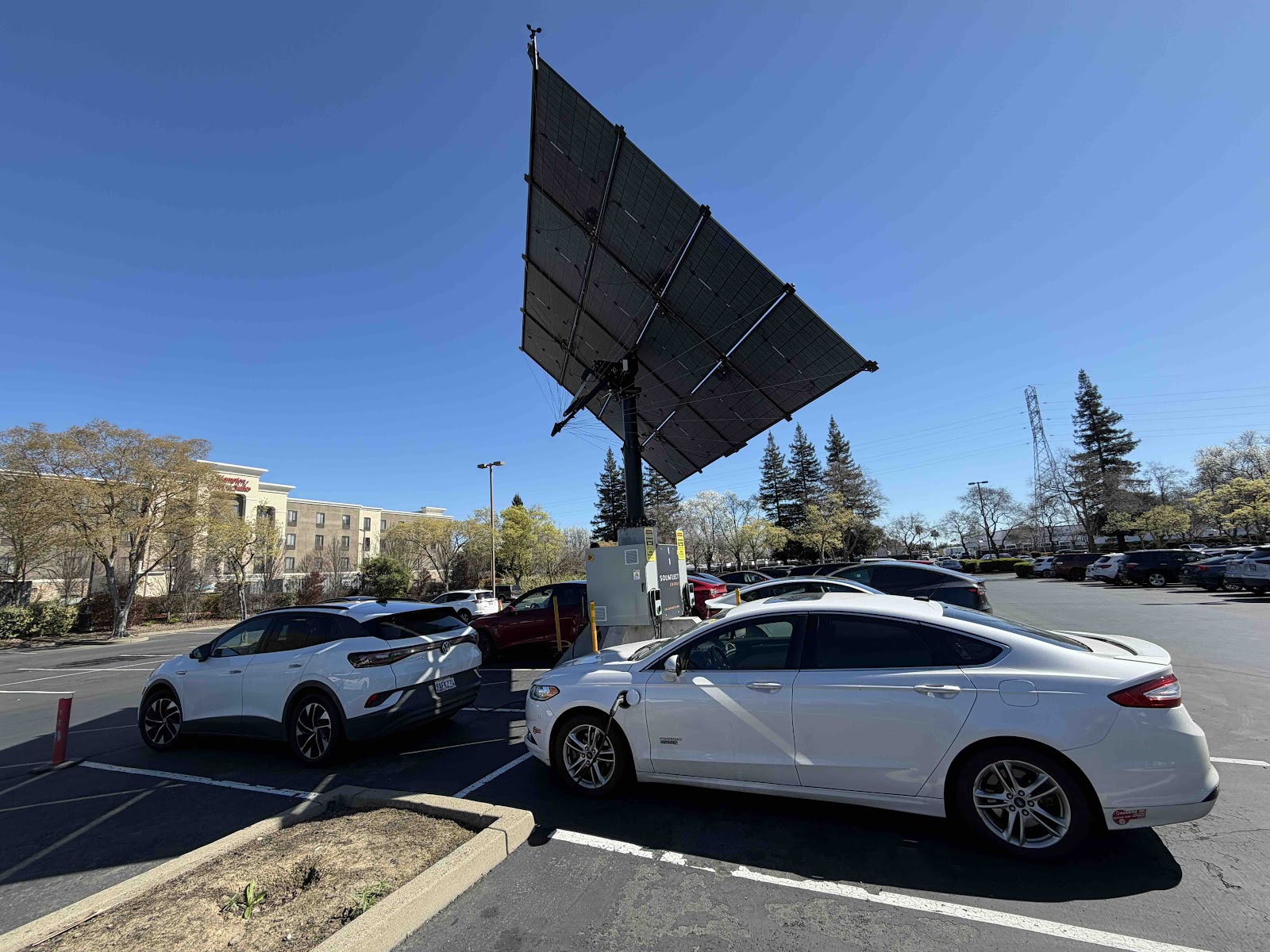
With demand, site conditions, incentives, and code in hand, you can compare approaches on equal footing. Grid-connected charging tends to make sense where capacity is available and chargers can sit close to existing power. Where capacity is tight or the best parking spaces sit far from the building, off-grid solar charging eliminates trenching and utility upgrades. Clear Blue Commercial offers an off-grid solar EV charging solution, and our comparison of grid-connected vs. off-grid commercial EV charging lays out the tradeoffs. Some properties end up using both.
Sixth: Settle Operations and Who Pays
This is the step most often left until after installation, and it causes the most friction. Answer these questions before the first car plugs in:
- Who pays for the electricity: the owner, the tenant, or the driver?
- Will charging be free, priced to recover costs, or priced as a modest amenity?
- If the chargers are on a house meter, how will costs be allocated or recovered through the lease?
- Who handles software, payment processing, and network subscriptions, if any?
- Who responds when a charger stops working, and how quickly?
- Who manages parking etiquette, signage, and time limits?
For multi-tenant properties, these answers often belong in lease language. For a single-tenant building, they may be a simple agreement. Either way, writing them down early prevents disputes later.
Seventh: Phase the Work
Few properties need to build for ten years of demand on day one. A phased plan installs what tenants need now while preparing for what comes next: conduit run while the paving is open, panel capacity sized with future ports in mind, and equipment that can be added to rather than replaced. Coordinating charging with other capital work, such as resurfacing or an electrical upgrade, is usually cheaper than doing each project separately. Our article on how sustainability changes commercial property capital planning explains that thinking more broadly.
Common Mistakes to Avoid
- Starting with a quote. A vendor quote answers the question you asked. Make sure it is the right question.
- Choosing spaces for visibility alone. The most visible spaces can be the most expensive to reach with power.
- Applying for incentives too late. Incentive steps that must happen before construction cannot be fixed afterward.
- Bundling scope without a code review. A panel upgrade or solar carport can change what the code requires.
- Leaving operations undefined. Unclear billing and maintenance responsibilities turn an amenity into a complaint.
- Overbuilding or underbuilding. Size for real demand, and prepare infrastructure for growth.
A note on federal incentives: the federal Section 30C charging credit applied to qualifying property installed through June 30, 2026, according to the U.S. Department of Energy. Owners should confirm current federal, state, and utility incentives with their tax advisor and program administrators.
EV charging works best as part of how a property is managed, not as a one-time equipment purchase. That is the approach behind our Sacramento commercial property management services.
Sacramento EV Charging Planning FAQs
What should a Sacramento property owner do first when planning EV charging?
Define the goal and the users. Knowing who will charge, how long they stay parked, and why you are adding charging shapes the number of ports, the charging speed, and the budget before any equipment is chosen.
Do I need to apply for SMUD incentives before installing chargers?
SMUD’s Commercial EV Program Manual describes reserving the incentive before the project moves into construction. Confirm current steps and requirements with SMUD at the start of planning so the timing does not cost you eligibility.
Can an electrical upgrade trigger EV charging requirements?
It can. Under CALGreen, work on existing nonresidential parking that increases power supply to an electric service panel, or new solar installed over existing parking, can trigger EV requirements for the spaces being added or altered. Review scope with the building department during design.
Who should pay for the electricity used by EV chargers?
There is no single answer. Owners may absorb it as an amenity, recover it through driver fees, or allocate it to tenants through the lease. The important thing is to decide before installation and document it.
Should I install all the chargers I might ever need at once?
Usually not. A phased approach installs what current demand supports and prepares conduit and electrical capacity for growth, which keeps upfront cost reasonable without forcing expensive rework later.
Related Reading
- → Commercial EV Charging in Sacramento
- → Sacramento Commercial Property Management
- → West Sacramento Commercial Property Management: Questions to Ask Before You Hire
- → What an Off-Grid Solar EV Charging Install Teaches West Sacramento Property Owners
- → Sustainable Operations for West Sacramento’s Industrial and Riverfront Properties
- → Is Your Sacramento Commercial Property Ready for EV Charging?
- → Grid-Connected vs. Off-Grid Commercial EV Charging
Next Step
Not sure where your property stands? Clear Blue Commercial’s complimentary Sustainable Property ROI Audit Kit helps you look at infrastructure, operating costs, and future capital needs together, so EV charging fits a larger plan. Questions about a specific property? Contact Carolyn at carolyn@clearbluecommercial.com.