
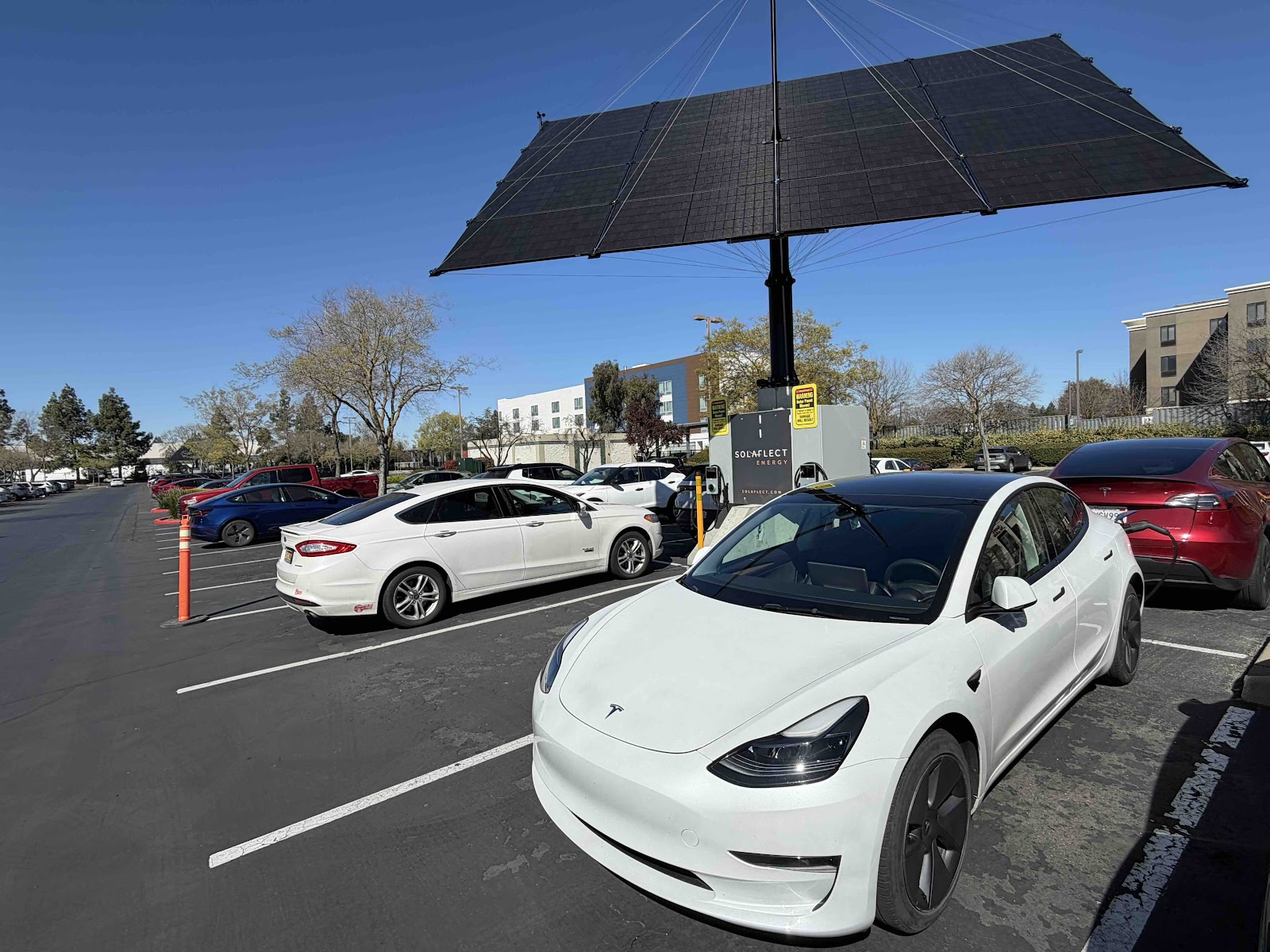
Off-grid solar EV charging looks simple from the parking lot: a solar unit, a charger, and a car plugged in. The lessons that matter most for owners are the ones you only see when you plan and install one.
Key Takeaways
- ✓ Where you put an off-grid unit matters more than which unit you buy. Sun, shade, and walking distance all count.
- ✓ Skipping the utility connection and trenching is the biggest practical advantage, especially on large lots.
- ✓ Off-grid charging fits daily commuter and visitor charging better than heavy fleet use.
- ✓ Installation can be fast, but permitting, placement, and tenant communication still need planning.
- ✓ Maintenance is light but not zero. Someone should own monitoring, cleaning, and user questions.
West Sacramento has a lot of what makes off-grid solar charging interesting: wide parking areas, strong sun for much of the year, and plenty of industrial and distribution sites where the electrical room is a long way from the spaces people actually use. It is also in PG&E territory, where a new service or transformer upgrade can take real time to schedule. Those conditions make it worth understanding what off-grid solar EV charging does well, where it falls short, and what owners tend to learn once a unit is in the ground.
This article sticks to general lessons that apply to most commercial sites. For the bigger picture on charging in the city, see our page on commercial EV charging in West Sacramento.
Lesson 1: Site Selection Is the Whole Game
With grid-connected charging, location is usually driven by where the power is. Off-grid charging flips that. Because the unit makes and stores its own energy, it can go almost anywhere on the lot, which means the owner has to make a deliberate choice instead of defaulting to the spot closest to the electrical room.
The best locations tend to share a few traits:
- Clear, all-day sun with no trees, buildings, or signs casting shadows during peak hours.
- A short, safe walk to the building entrance, so the spaces actually get used.
- Good visibility, which helps both drivers who are looking for a charger and security.
- Room for vehicles to pull in and out without blocking drive aisles or fire lanes.
- Accessible routes, signage, and striping that meet current requirements.
On a large West Sacramento lot, it is common to find that the sunniest corner is also the farthest from the door. Weighing those tradeoffs early, with input from tenants, prevents a well-built charger from sitting unused.
An off-grid charger can go almost anywhere. That is exactly why the location deserves careful thought.
Lesson 2: Sun Exposure Sets the Ceiling
An off-grid unit can only deliver the energy it collects. That makes sun exposure the limiting factor for how much charging the station can provide each day. Shade from a nearby building in winter, a tree that has grown over the years, or a planned structure on the next parcel can all reduce output.
Sacramento Valley summers are long and sunny, but winter days are shorter and the sun sits lower. A practical plan looks at year-round exposure, not just a bright day in June, and sets expectations with tenants about how much charging a unit can provide in different seasons.
Lesson 3: Avoided Trenching Is the Biggest Practical Win
On many commercial properties, the cost and disruption of grid-connected charging come less from the charger and more from getting power to it: cutting and patching asphalt, running conduit, upgrading panels, and coordinating with the utility. On a distribution site with heavy-duty paving, or a lot that stays busy all day, that work can be hard to schedule.
Off-grid charging eliminates it. No trench across the lot, no new utility service, and no need to wait for a transformer upgrade before drivers can plug in. For owners whose electrical service is already near capacity, especially food and cold storage properties, that can be the difference between adding charging now and putting it off for years. Our comparison of grid-connected vs. off-grid commercial EV charging goes deeper on when each approach makes more sense.
Lesson 4: Installation Can Be Fast, but Planning Still Takes Time
Because there is less site work, off-grid units can often be installed quickly once everything is ready. The Clear Blue solar EV charging solution is designed for that kind of streamlined installation.
The part that still takes time is everything before installation day: confirming the location, reviewing permit requirements with the city, checking accessibility and signage, coordinating delivery with tenant operations, and deciding who can use the chargers and how. Owners who start that work early get the benefit of a short install. Owners who skip it can end up with a fast installation in the wrong place.
Lesson 5: Match the Charger to the Demand
Off-grid solar charging is a strong fit for some uses and a weak fit for others. It tends to work well for:
- Employees who park for most of the day and need a modest daily top-up.
- Visitors and customers who want a convenient, visible charging option.
- Overflow or remote parking areas where running power would be expensive.
- Properties that want to start offering charging while larger upgrades are planned.
It is usually not the right tool for vehicles that need large amounts of energy every day, such as delivery fleets running long routes or trucks that return to the yard nearly empty. Those vehicles generally need grid-connected charging sized to the fleet’s schedule. On many West Sacramento industrial sites, the sensible answer is a mix: off-grid units for employee and visitor parking, and grid-connected charging near the loading area for the fleet.
Off-grid charging works best when it is matched to daily needs, not asked to do a fleet depot’s job.
Lesson 6: Maintenance Is Light, but Someone Has to Own It
With no utility connection and fewer site components, off-grid units generally need less ongoing attention than a large grid-connected installation. Less is not none. Solar panels collect dust and pollen, especially near busy roads and industrial activity. Batteries and electronics should be monitored. Drivers will have questions, and a charger that is out of service needs a clear path to repair.
The most useful step is simply assigning ownership. Decide who checks performance, who handles cleaning, who answers user questions, and how issues get reported. That fits naturally into hands-on commercial property management, where someone is already on site and responsible for the parking area.
Lesson 7: Off-Grid Charging Still Belongs in the Capital Plan
An off-grid unit can be a smart first step, but it should not be a one-off. It works best as part of a longer plan that considers future tenant demand, fleet changes, and code requirements. Under the 2025 CALGreen standards, for example, a new solar system over existing parking can bring EV charging requirements, and certain new buildings with loading spaces must be ready for medium- and heavy-duty EV charging. Knowing those rules helps owners decide where off-grid charging fits and where grid-connected capacity will eventually be needed.
It also helps to think about off-grid charging alongside other efficiency and resilience work. Our page on sustainable commercial property management in West Sacramento covers that broader view, and sustainable operations for West Sacramento’s industrial and riverfront properties looks at practical steps for the city’s most common building types.
Putting the Lessons to Work
For a West Sacramento owner considering charging, the lessons point to a simple sequence. Start by understanding who will charge and how much. Walk the site with sun and shade in mind. Check the existing PG&E service and what it would take to add load. Then compare a grid-connected plan, an off-grid plan, and a combination on total cost, timing, and fit. The answer will differ from one property to the next, and that is the point. The right setup comes from the site, not the brochure.
Off-Grid Solar EV Charging FAQs
What is off-grid solar EV charging?
It is a charging station powered by its own solar panels and battery storage instead of a connection to the utility grid. Because it does not need a new electrical service or trenching to the building, it can be placed in parking areas that would be expensive to reach with wiring.
Does off-grid solar charging work in winter?
Yes, but output is lower when days are shorter and the sun is lower. Planning should look at year-round sun exposure and set expectations with tenants about how much charging the unit can provide in each season.
Can off-grid units charge delivery vans or trucks?
They are generally better suited to daily commuter and visitor charging. Vehicles that use a lot of energy every day, such as delivery fleets, usually need grid-connected charging sized to the fleet’s schedule.
Do off-grid chargers need a permit?
Permit requirements depend on the project and the jurisdiction. Owners should confirm requirements with the City of West Sacramento, along with accessibility, signage, and striping needs, before installation.
Is off-grid charging better than grid-connected charging?
Neither is better in every case. Off-grid charging shines where power is hard to reach or the service is full. Grid-connected charging fits higher-demand uses. Many properties benefit from a mix of both.
Related Reading
- → Commercial EV Charging in West Sacramento
- → Commercial EV Charging in Sacramento
- → Solar EV Charging Solution
- → Grid-Connected vs. Off-Grid Commercial EV Charging: Which Solution Is Right for Your Property?
- → Commercial EV Charging in Sacramento: What Property Owners Should Plan For First
- → West Sacramento Commercial Property Management: Questions to Ask Before You Hire
- → Sustainable Operations for West Sacramento’s Industrial and Riverfront Properties
Next Step
Wondering whether off-grid, grid-connected, or a mix makes sense for your property? Start with the complimentary Sustainable Property ROI Audit Kit, or contact Carolyn at carolyn@clearbluecommercial.com to talk through your site.