
Sustainable Commercial Property Management in West Sacramento
Lower operating costs, steadier building performance, and capital plans built for a riverfront city that is still growing.
West Sacramento Sustainability Strategy
In West Sacramento, sustainability decisions show up in the same places as every other operating decision: the utility bill, the maintenance log, and the capital plan.
West Sacramento sits directly across the Sacramento River from downtown Sacramento, but it operates under a different set of conditions. It is in Yolo County, not Sacramento County. Its commercial properties are served by PG&E rather than SMUD. Its building stock leans heavily toward industrial, distribution, and flex space, alongside a riverfront that has been changing from rice mills and industrial land into housing, offices, restaurants, and mixed-use development. Those differences shape which programs apply, which costs dominate, and where the practical savings are.
Clear Blue Commercial brings sustainability into everyday West Sacramento commercial property management. That means looking at how a building actually uses energy and water, finding recurring waste, and helping owners decide which improvements make financial sense now, which belong in the capital plan, and which can wait. The goal is not sustainability at any cost. It is sustainability that improves the business case.
Start Here
Five Questions for West Sacramento Owners
- ✓ How have electricity, gas, and water use changed over the last two to three years?
- ✓ Which systems run when the building or warehouse floor is empty?
- ✓ Is the property over 50,000 square feet and subject to state energy benchmarking?
- ✓ Which PG&E rebates, financing, or small business programs could apply?
- ✓ What major replacements (roof, HVAC, lighting, paving) are coming in the next five years?
The Short Version
What West Sacramento Owners Should Know About Sustainable Property Management
Sustainable property management in West Sacramento starts with measuring how the building operates, then fixing recurring waste before buying new equipment. Local factors matter: PG&E is the utility, summers are hot, much of the building stock is industrial, and the City adopted a Climate Action and Adaptation Plan in 2025 that points toward future expectations for existing commercial buildings.
Key Takeaways
- ✓ West Sacramento is served by PG&E, so SMUD programs that Sacramento owners use do not apply here.
- ✓ HVAC, lighting, and refrigeration usually drive energy costs, and July highs average in the low 90s.
- ✓ California requires annual energy benchmarking for commercial buildings over 50,000 square feet.
- ✓ The City’s 2025 climate plan targets carbon neutrality by 2045 and lists future performance standards for existing commercial buildings as a planned action.
- ✓ The best results usually come from phasing improvements into maintenance and capital plans, not one large project.
Why Read This
Operating expenses affect net operating income as directly as rent does. Energy, water, maintenance, and waste costs that creep upward year after year quietly reduce what a property is worth.
This page explains how sustainability applies to West Sacramento’s specific mix of properties, which local and state requirements are worth tracking, and how to turn good intentions into a practical, phased plan.
Local Context
Why West Sacramento Needs Its Own Approach
It is easy to treat West Sacramento as an extension of Sacramento. From an operating standpoint, that can lead to the wrong assumptions. The Sacramento River is also the county line, and most of the incentive programs, utility rates, and local rules a Sacramento owner relies on stop at the water.
The biggest difference is the electric utility. SMUD serves Sacramento County and parts of Placer County. West Sacramento, like the rest of Yolo County, is served by PG&E, and a 2006 proposal to annex West Sacramento, Davis, and Woodland into SMUD’s territory was rejected by voters. For owners, that means energy efficiency rebates, financing, demand response programs, rate options, and EV programs all come from PG&E and its program partners.
Water is local too. The City of West Sacramento draws its water from the Sacramento River at Bryte Bend and treats it at the George Kristoff Water Treatment Plant. The City adopted a permanent outdoor watering schedule in 2022 and has signaled more attention to landscape water use, including a planned ban on non-functional turf in the municipal code.
Then there is the heat. West Sacramento’s average daily highs are 88 degrees in June, 93 in July, and 92 in August, with a record high of 113. Every hot afternoon is a test of rooftop units, building envelopes, and control schedules.
West Sacramento at a Glance
Local Factors That Shape Operating Costs
- ✓ Yolo County city of about 54,000 residents (2020 Census)
- ✓ Electric utility: PG&E, not SMUD
- ✓ City water drawn from the Sacramento River and treated locally
- ✓ Permanent outdoor watering schedule since 2022
- ✓ Hot summers with July average highs near 93 degrees
- ✓ Climate Action and Adaptation Plan adopted June 2025
Property Types
Where Sustainability Shows Up in West Sacramento’s Building Stock
West Sacramento’s economy runs on logistics, food, government, and a growing riverfront. Each property type has its own pressure points.
Industrial and Distribution
Big roofs, big doors, long hours.
Warehouse, flex, and distribution buildings along corridors like Industrial Boulevard and near the Port of West Sacramento often run lighting and equipment across long shifts. High-bay lighting, dock door air loss, conditioned office areas, forklift and fleet charging, and roof condition tend to drive both energy use and capital needs.
Food and Cold Storage
Refrigeration is the meter to watch.
West Sacramento promotes itself as a food industry hub, and food distribution is among its larger employers. Refrigerated space carries high, around-the-clock energy loads, so maintenance of compressors, door seals, and controls has a direct effect on operating cost and product protection.
Riverfront Mixed-Use
Shared systems, shared expectations.
The Bridge District and the riverfront near Tower Bridge have added housing, restaurants, and commercial space on former industrial land. Mixed-use buildings combine residential and commercial loads, shared common areas, landscaping, and parking, which makes metering, cost allocation, and tenant communication part of the sustainability conversation.
Office and Professional
Schedules matter as much as equipment.
Large public-sector employers such as the Department of General Services and CalSTRS anchor office demand in the city. For private office properties, HVAC scheduling, lighting controls, and how well systems match actual occupancy patterns often reveal the quickest savings.
Retail and Service Commercial
Customers notice comfort first.
Retail centers and service businesses along West Capitol Avenue and other commercial corridors depend on comfortable, well-lit spaces and attractive landscaping. Parking lot lighting, irrigation, and rooftop HVAC maintenance are common places to find recurring waste.
Owner-User Facilities
Operating costs land on the owner.
When the owner also occupies the building, every efficiency gain shows up directly in the operating budget. These properties often benefit most from a structured look at utility history and equipment age before the next replacement cycle.
The right priorities depend on the property. A distribution building and a riverfront mixed-use project can share a zip code and have almost nothing in common on the utility bill.
Energy
Energy Efficiency on PG&E Territory
PG&E notes that heating, ventilation, and air conditioning can account for roughly 40 to 50 percent of a commercial building’s energy use. In a climate with long stretches of 90-degree days, that share is where most West Sacramento properties should look first. Rooftop units that are past their prime, economizers that no longer work, dirty coils, and thermostats that run full schedules for partly occupied buildings all add cost without adding comfort.
PG&E offers several paths that can help. Its business energy efficiency rebates cover categories such as HVAC, refrigeration, insulation, and water heating, and its small and medium business offerings include instant discounts and some no-cost direct install measures like smart thermostats and LED retrofit kits. PG&E also lists energy efficiency financing for qualifying upgrades, demand response programs, and battery storage paired with solar to manage demand charges. Some programs are delivered directly by PG&E and others by partners PG&E selects.
Program terms, funding, and eligibility change, and PG&E notes that rebate funding is limited and first come, first served. Owners should confirm current details, and confirm that a product qualifies, before buying or installing equipment. A property manager who tracks those requirements can keep a good project from missing an incentive on a technicality.
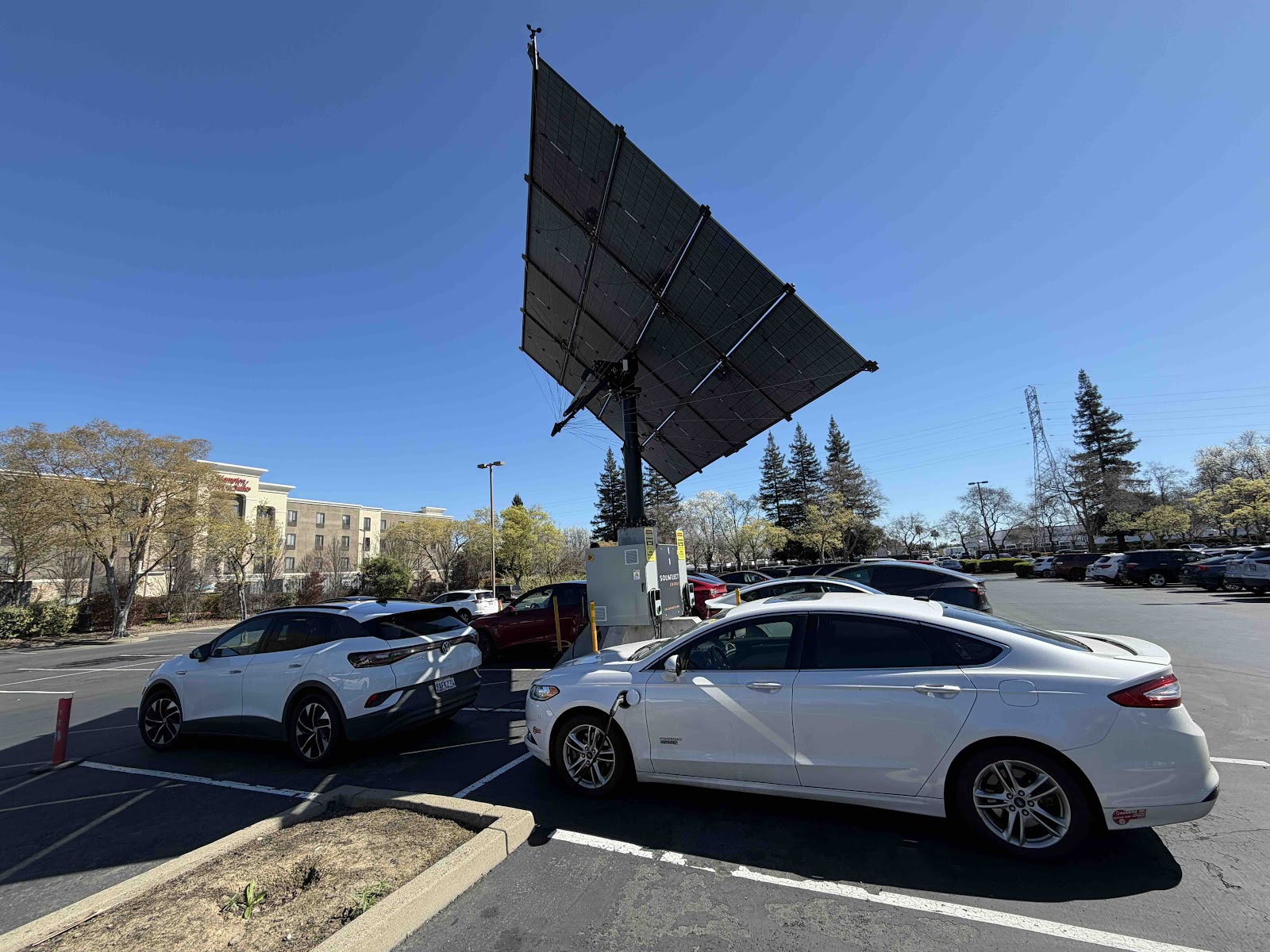
Clear Blue also helps owners evaluate on-site energy, including our off-grid solar EV charging solution, as part of a broader plan rather than a standalone purchase.
Before you replace it, measure it. Many energy problems are scheduling, controls, or maintenance problems first.
Water and Landscaping
A River City Still Has to Manage Water Carefully
Being next to the Sacramento River does not make water free. West Sacramento treats and delivers its own supply, and the City has made water efficiency part of its climate plan, citing more than 700 completed Water Wise House Calls, a permanent watering schedule, and rebate programs, along with a planned ban on non-functional turf.
For commercial owners, the largest controllable water use is usually outdoors. Irrigation systems on industrial campuses, retail centers, and riverfront landscapes can run on outdated schedules, overspray onto pavement, or leak for weeks before anyone notices. Indoors, restrooms, break rooms, food service, and cooling equipment all create opportunities to spot leaks and unusual changes in use.
Turf that exists only to be mowed is worth a second look, both for the water bill and for where City policy is heading. Converting non-functional turf in phases, upgrading to weather-based irrigation controls, and checking the system after every landscaping change are practical steps that can reduce water and maintenance costs without making a property look neglected.
Irrigation waste is easy to miss because no one is standing there when it happens.
Quick Water Checks
Worth Reviewing This Year
- ✓ Irrigation schedule versus the City’s watering rules
- ✓ Overspray, broken heads, and runoff onto paving
- ✓ Monthly water use trends, especially in winter
- ✓ Non-functional turf that could be converted over time
Rules and Reporting
Benchmarking, Title 24, and the City’s Climate Plan
California’s Building Energy Benchmarking Program, administered by the California Energy Commission, requires owners of commercial buildings with more than 50,000 square feet of gross floor area and no residential utility accounts to report energy use every year by June 1. Multifamily buildings over 50,000 square feet with 17 or more utility accounts must report as well. The CEC publishes building performance data on a public dashboard. For larger West Sacramento warehouses and distribution buildings, benchmarking is both a compliance task and a useful management tool, because it shows how a building compares with itself over time.
California’s Building Energy Efficiency Standards (Title 24, Part 6) apply to new buildings and to additions and alterations to existing buildings, and they are updated every three years. The 2025 standards took effect on January 1, 2026. Lighting retrofits, HVAC replacements, and envelope work can all trigger code requirements, so they belong in project scoping from the start.
Locally, West Sacramento’s City Council adopted a Climate Action and Adaptation Plan on June 4, 2025, with a roadmap toward carbon neutrality by 2045. The plan lists actions to set energy performance standards and greenhouse gas limits for existing commercial buildings, to offer electrification incentives for existing buildings, and to encourage warehouse and distribution operators to transition fleets to zero-emission vehicles. As of the City’s latest update, the building actions had not started, and their details are not set. Owners do not need to act on rules that do not exist yet, but it is sensible to know where the conversation is going when planning equipment that will last 15 to 20 years.
Compliance and Planning
Track These for Your Property
- ✓ CEC benchmarking (over 50,000 sq ft), due June 1 each year
- ✓ Title 24 requirements for planned alterations and replacements
- ✓ West Sacramento Climate Action and Adaptation Plan updates
- ✓ City watering schedule and landscape rules
How We Approach It
A Practical Path to a More Efficient West Sacramento Property
Sustainable management works best as a routine, not a one-time project. Here is how Clear Blue Commercial helps owners move from questions to measurable progress.
01
Establish the Baseline
Gather two to three years of PG&E and water data, maintenance records, and equipment ages. Set up ENERGY STAR Portfolio Manager tracking where it helps, and confirm whether state benchmarking applies.
02
Find the Recurring Waste
Walk the property, review HVAC schedules and controls, check lighting and irrigation, and look for equipment running when no one needs it. Many of the best opportunities cost little to fix.
03
Prioritize by Business Case
Rank opportunities by cost, expected savings, available PG&E incentives, equipment life, tenant impact, and timing, so owners can compare options on equal terms.
04
Phase, Measure, and Improve
Coordinate work with existing maintenance and capital schedules, confirm results against the baseline, and keep adjusting as tenants, rates, and requirements change.
Capital Planning
Sustainability Belongs in the Capital Plan
The most cost-effective time to improve efficiency is usually when something already needs to be replaced. When a rooftop unit fails, the real comparison is not a high-efficiency unit versus doing nothing. It is one replacement option versus another, including operating cost over the equipment’s life. The same logic applies to roofs, lighting, parking lot work, and electrical upgrades.
West Sacramento’s large industrial roofs and parking areas deserve particular attention. A roof replacement may be the moment to evaluate solar readiness. A paving project is a natural time to run conduit for future EV charging, especially if tenants are considering fleet changes. Our West Sacramento commercial EV charging page covers that planning in more detail.
Choosing a partner matters too. Look for a manager who reads utility data, understands PG&E programs and Title 24 triggers, knows the property types in West Sacramento, and shows up in person. Clear Blue Commercial is a Certified B Corporation, a California Green Business, a woman-owned business, and an approved vendor for the State of California, and we provide hands-on property and facilities management across the greater Sacramento region.
Good Times to Revisit Efficiency
Coordinate Improvements With
- ✓ HVAC or rooftop unit replacement
- ✓ Roof replacement or recoating
- ✓ Parking lot resurfacing or restriping
- ✓ Lighting failures or tenant improvements
- ✓ Lease renewals and new tenant move-ins
Owner Questions
West Sacramento Sustainable Property Management FAQs
Who provides electricity to commercial properties in West Sacramento?
West Sacramento is served by PG&E. SMUD serves Sacramento County and parts of Placer County, so SMUD rebates and rate programs do not apply to West Sacramento properties. Energy efficiency rebates, financing, and EV programs for West Sacramento owners come through PG&E and its program partners.
Does my West Sacramento building have to report energy use to the state?
If it is a commercial building with more than 50,000 square feet of gross floor area and no residential utility accounts, California’s Building Energy Benchmarking Program requires annual reporting by June 1. Multifamily buildings over 50,000 square feet with 17 or more utility accounts must also report. Confirm current requirements with the California Energy Commission.
Will West Sacramento require existing commercial buildings to meet energy performance standards?
The City’s 2025 Climate Action and Adaptation Plan lists energy performance standards and greenhouse gas limits for existing commercial buildings as a planned action. As of the City’s latest update, that action had not started and no requirements have been set. It is worth watching as you plan long-life equipment.
What PG&E programs can help reduce energy costs?
PG&E lists business rebates for HVAC, refrigeration, insulation, and water heating, small business instant discounts and no-cost direct install measures, energy efficiency financing, and demand response programs. Funding is limited and terms change, so confirm eligibility and current details with PG&E before purchasing equipment.
How does Clear Blue Commercial help West Sacramento owners?
We integrate sustainability into day-to-day property and facilities management: establishing a baseline, finding recurring waste, prioritizing improvements by business case, coordinating vendors, and folding efficiency into maintenance and capital planning. Our complimentary Sustainable Property ROI Audit Kit is a good place to start.
Keep Learning
Continue Exploring
More resources for West Sacramento and Sacramento-area property owners.
Sustainable Commercial Property Management in Sacramento
Our regional guide to where sustainability, operating costs, and asset performance meet.
West Sacramento Commercial Property Management
Hands-on management for West Sacramento office, industrial, and mixed-use properties.
Commercial EV Charging in West Sacramento
How to plan charging for tenants, visitors, and fleets on PG&E territory.
Sustainable Operations for Industrial and Riverfront Properties
Practical operating-cost steps for West Sacramento warehouses and mixed-use buildings.
Energy and Water Efficiency: The Hidden ROI
Why everyday efficiency can matter more to returns than a single big project.
See Where Your West Sacramento Property Can Improve
Whether you own a distribution building, a riverfront mixed-use property, or an office or retail center, the first step is understanding how the building is operating today.
Clear Blue Commercial’s complimentary Sustainable Property ROI Audit Kit helps owners review energy, water, maintenance, and capital needs together, so improvements are chosen for the business case, not the brochure.