
Commercial EV Charging in West Sacramento
Charging plans built for riverfront offices, distribution buildings, and fleet yards on the PG&E side of the river.
West Sacramento EV Charging Strategy
West Sacramento sits across the river from the capital, but its EV charging decisions run through a different utility, a different county, and a very different mix of properties.
A short drive over the Tower Bridge changes more than the skyline. West Sacramento is in Yolo County and is served by PG&E rather than SMUD, so the utility programs, service rules, and timelines that shape a charging project are not the ones owners use in Sacramento. The building stock is different too: state offices and riverfront mixed-use on one end of the city, and warehouses, food processing, and distribution buildings near the Port on the other.
Clear Blue Commercial helps owners treat EV charging as part of West Sacramento commercial property management, not a one-time equipment order. That means starting with how people and vehicles actually use a site, checking what the electrical system and the PG&E service can support, and fitting charging into the property’s larger capital plan.
Start Here
Six Questions for West Sacramento Owners
- ✓ Are you planning for employee and visitor cars, tenant fleets, or both?
- ✓ Does the building have loading docks that may need truck charging later?
- ✓ How much spare capacity does the existing PG&E service have?
- ✓ Would chargers sit near the electrical room or across a large lot?
- ✓ Is a permit-triggering alteration or addition already on the calendar?
- ✓ Could an off-grid solar unit serve some spaces without new utility work?
The Short Version
What West Sacramento Owners Should Know Before Adding EV Charging
In West Sacramento, a good charging plan starts with the property’s users and vehicles, then works through the PG&E service path, current code triggers, and long-term fleet needs. Because so much of the city’s commercial space supports logistics and food distribution, owners often need to think about vans and trucks as well as passenger cars. Off-grid solar charging can be a useful option for spaces that are hard to reach with new wiring.
Key Takeaways
- ✓ West Sacramento is served by PG&E, so the SMUD programs Sacramento owners use do not apply here.
- ✓ PG&E’s EV Fleet program closed to new applications on June 30, 2026, so confirm what is open before budgeting around an incentive.
- ✓ The 2025 CALGreen code adds medium- and heavy-duty EV readiness for certain new buildings with loading spaces, including warehouses.
- ✓ The city’s 2025 Climate Action and Adaptation Plan names transportation as its largest emissions source and includes outreach to warehouses on zero-emission fleets.
- ✓ Off-grid solar charging can serve some spaces without trenching or a new utility service, depending on sun, layout, and demand.
Why Read This
Many West Sacramento properties will face charging decisions from two directions at once: tenants asking for workplace charging, and fleet operators planning for electric vans and trucks. Those needs call for different equipment, different power levels, and sometimes different locations on the same site.
This page covers the local context, the property types that feel the most pressure, and a practical way to plan charging so it supports leasing and operations without overbuilding.
Local Context
Why West Sacramento Is Its Own EV Charging Market
West Sacramento had 53,915 residents in the 2020 Census and sits on the west bank of the Sacramento River, which also forms the line between Sacramento and Yolo counties. Its largest employers include the California Department of General Services and CalSTRS, whose riverfront headquarters is the city’s tallest building, along with food and distribution companies such as Tony’s Fine Foods and the Raley’s headquarters. Since 2011 the city has also promoted itself as a food innovation hub, which brings processing, cold storage, and distribution space with it.
That mix matters for charging. An office building near the river sees long employee dwell times, which suits Level 2 charging. A distribution building may need fewer chargers for cars and more thought about delivery vans, yard equipment, and future heavy-duty trucks. A food facility may already be running close to its electrical limits because of refrigeration, which changes how much new load it can take on.
The City of West Sacramento has made electrified transportation part of its long-term planning. Its Climate Action and Adaptation Plan, adopted by City Council on June 4, 2025, sets a path to carbon neutrality by 2045 and identifies transportation as roughly 64 percent of local greenhouse gas emissions. Actions in the plan include expanding public EV charging and outreach to warehouse and distribution centers about zero-emission fleets. For owners, that is a useful signal about where tenant and public expectations are heading.
West Sacramento at a Glance
Local Factors That Shape a Project
- ✓ Electric service from PG&E, not SMUD
- ✓ Yolo County and the Yolo-Solano Air Quality Management District
- ✓ City climate plan targeting carbon neutrality by 2045
- ✓ A large share of logistics, food, and distribution space
- ✓ Riverfront mixed-use growth in the Bridge District
Property Types
Where Charging Questions Show Up First in West Sacramento
Charging needs look different across the city’s main property types. Matching the plan to how each one is used avoids paying for the wrong kind of capacity.
Riverfront and Downtown Office
Long stays, steady demand.
Employees who park for a full workday can usually be served well by Level 2 charging. The key questions are how many spaces, who pays for the electricity, and how access is managed among tenants.
Warehouse and Distribution
Plan for vans and trucks, not just cars.
Tenants running delivery or service vehicles may need charging matched to shift schedules and routes, often near loading areas. That can mean higher power and a separate conversation with PG&E.
Food Processing and Cold Storage
Check existing load first.
Refrigeration and process equipment can leave little spare capacity. A load study before choosing chargers helps avoid surprises, and managed charging can keep new demand off peak periods.
Riverfront Mixed-Use
Shared parking, many users.
In the Bridge District and similar mixed-use areas, residents, shoppers, and office workers may share parking. Access, billing, and time limits need as much thought as the hardware.
Port-Area Industrial
Large lots, long distances.
Big yards near the Port can put desired charging spots far from electrical rooms. Trenching across heavy-duty paving adds cost and disruption, which is where off-grid options deserve a look.
Retail and Hospitality
Short visits, visible amenity.
Customers who stay under an hour need a different mix than employees. Fewer, well-placed chargers with clear signage often do more for the property than many slow ports.
Most properties have more than one type of user. A plan that separates employee, visitor, and fleet charging is usually easier to fund and expand.
Working With PG&E
The Utility Side of a West Sacramento Charging Project
Because West Sacramento is in PG&E territory, owners who have worked on Sacramento properties should not assume the same incentive programs or process. The utility’s timeline for reviewing load, upgrading a transformer, or building a new service can drive the overall schedule more than equipment lead times do.
PG&E’s Electric Rule 29 provides a path for separately metered EV charging at non-residential sites. At the time of writing, the tariff describes PG&E planning, building, and owning the utility-side service extension up to the meter, while the customer installs, owns, and maintains the charging equipment and agrees to keep it operating for a set period. Whether Rule 29 or a standard service upgrade makes more sense depends on the project, so it is worth asking early.
Incentive availability has also shifted. According to PG&E’s July 2026 program advisory council update, the EV Fleet program closed its application window on June 30, 2026 and expects to use its full infrastructure budget, while EV Advisory Services is scheduled to end in 2026. The federal Section 30C charger tax credit applied only to property placed in service through June 30, 2026. The Yolo-Solano Air Quality Management District runs a Clean Air Funds grant cycle that has been open to private companies, but its focus and deadlines change each year. The practical takeaway: confirm what is open at the start of planning, and build a business case that still works if an incentive does not come through.
Start the utility conversation early. In many projects, PG&E’s timeline is the schedule.
Code and Fleet Readiness
What Current CALGreen Rules Mean for West Sacramento Buildings
California’s 2025 CALGreen nonresidential standards took effect on January 1, 2026. For new construction, they set minimum numbers of EV capable spaces and installed charging stations based on parking count, with higher installed-charger requirements for office and retail uses.
Two parts of the code are especially relevant here. First, certain new warehouses, grocery stores, retail stores, office buildings, and manufacturing facilities with planned off-street loading spaces must be ready for medium- and heavy-duty EV charging. That means spare raceway, electrical capacity reserved at the transformer or panel, and a set-aside location near the loading area. In a city with as much distribution space as West Sacramento, that requirement will shape a meaningful share of new industrial projects.
Second, EV requirements can apply to existing properties when the parking area is altered and the work increases power to an electric service panel, or when a new solar system is installed over existing parking. An owner planning a solar carport, a lot rebuild, or a larger tenant improvement should check EV obligations during design rather than after. Requirements should always be confirmed with the City of West Sacramento’s building division for the specific project.
Check Before You Build
Projects That Can Bring EV Requirements
- ✓ New buildings with parking or loading spaces
- ✓ Parking lot alterations that add power to a panel
- ✓ New solar carports over existing parking
- ✓ Larger additions or alterations under CALGreen scoping
- ✓ Tenant fleet changes that need new service capacity
Grid-Connected or Off-Grid
Where Off-Grid Solar Charging Fits in West Sacramento
Grid-connected charging is the right answer for many sites, especially where spare capacity exists and chargers can sit close to the electrical room. It becomes harder when the service is already full, when PG&E upgrades would add months, or when the spaces that make sense for charging are across a wide lot.
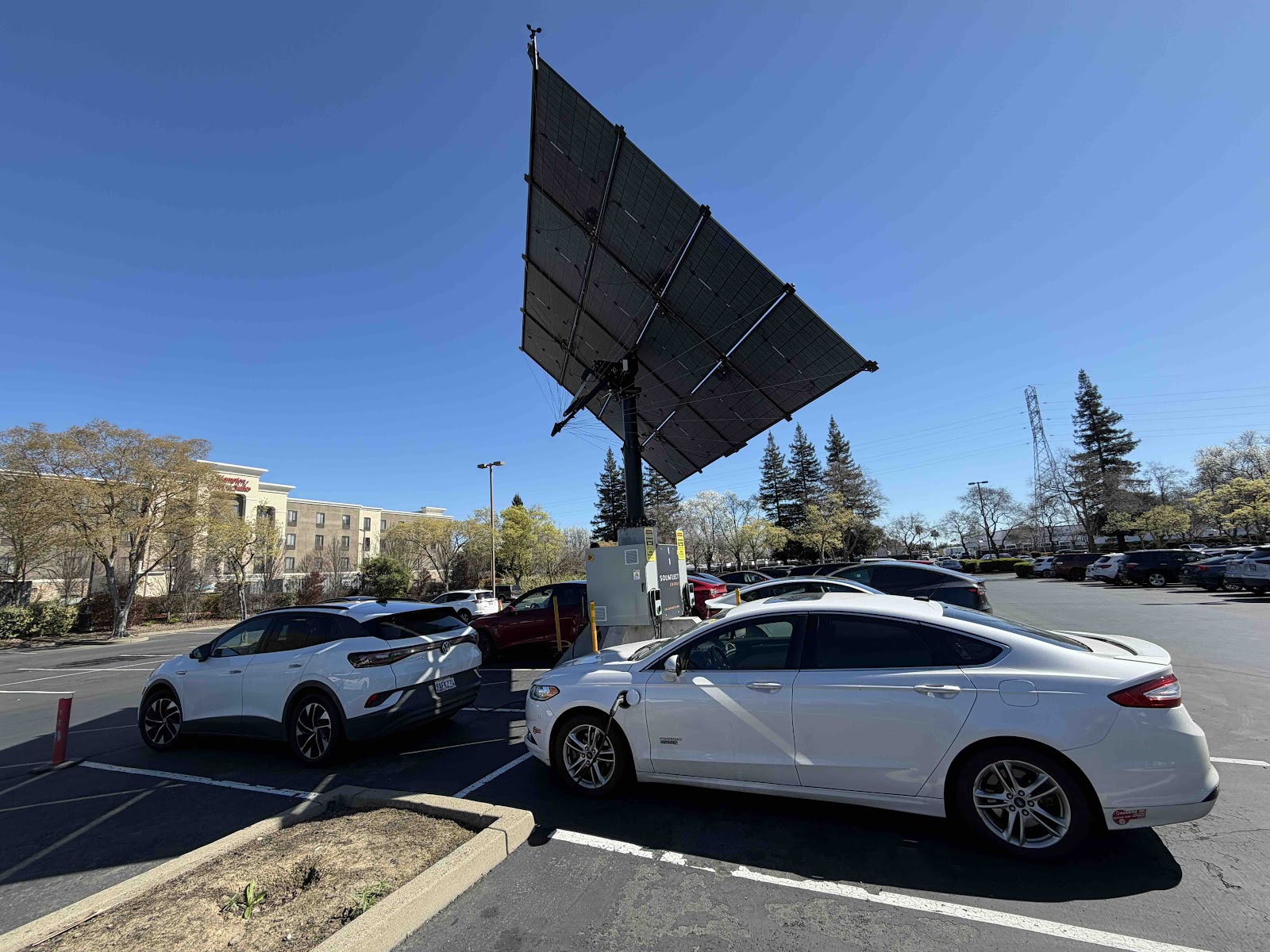
Off-grid solar EV charging takes a different approach. A self-contained solar unit generates and stores its own energy, so it can serve parking spaces without a utility connection or long trenching runs. Clear Blue Commercial offers a solar EV charging solution and has hands-on experience with off-grid solar charging installations in the Sacramento region.
West Sacramento’s open, sunny parking areas can suit this approach, but it is not a fit everywhere. Off-grid units deliver a limited amount of energy each day, so they work best for daily commuting and visitor charging rather than heavy fleet use, and they need unshaded space. Many properties end up with a combination: grid-connected charging where power is easy to reach and off-grid units where it is not. Our guide to grid-connected vs. off-grid commercial EV charging covers the tradeoffs in more detail, and our article on what an off-grid solar EV charging install teaches property owners looks at the practical lessons.
The best charging setup is often a mix: grid power where it is easy, solar where it is not.
How We Approach It
A Practical Path for West Sacramento Properties
Clear Blue Commercial’s approach keeps the decision grounded in how the property is used, what PG&E and the code require, and what the budget can support.
01
Map Users and Vehicles
Talk with tenants about employee commuting, visitor traffic, and fleet plans, including any vans or trucks they expect to electrify in the next few years.
02
Assess Power and Site
Review the existing PG&E service, panel capacity, refrigeration or process loads, parking layout, and distances, then identify where grid-connected, off-grid, or both make sense.
03
Check Code and Incentives
Confirm CALGreen triggers for planned work, ask PG&E about Rule 29 and service timelines, and check which utility, air district, and state programs are open.
04
Phase, Install, and Operate
Start with the spaces that serve current demand, prepare conduit for the next phase, coordinate installation around operations, and set up maintenance and billing.
Think Long Term
Build Charging Into the Capital Plan
Charging costs the least when it rides along with work that is already happening. If a yard is being repaved, that is the time to lay conduit toward future truck parking. If a tenant is expanding cold storage and the service is being upsized anyway, sizing it with EV load in mind can save a second upgrade. If a solar carport is planned, the code may require EV infrastructure regardless, so it makes sense to design both together.
Future-ready does not mean overbuilt. Installing far more capacity than tenants will use for years rarely pencils out. A phased plan that installs what is needed now, prepares the pathways for the next step, and leaves room on the electrical system is usually the most defensible use of capital.
For more on the electrical side, see how to evaluate electrical capacity before installing EV charging. Owners thinking about broader efficiency upgrades alongside charging may also find our page on sustainable commercial property management in West Sacramento useful.
Good Times to Plan Charging
Coordinate EV Charging With
- ✓ Yard or parking lot repaving and restriping
- ✓ Electrical service upgrades for new tenant loads
- ✓ Solar carport or roof solar projects
- ✓ Lease renewals with fleet-operating tenants
- ✓ Tenant improvements that trigger CALGreen review
Owner Questions
West Sacramento Commercial EV Charging FAQs
Which utility serves commercial properties in West Sacramento?
West Sacramento is in PG&E’s service territory. That means SMUD’s commercial EV incentives, which many Sacramento owners rely on, do not apply. Owners should work with PG&E on load reviews, service upgrades, and any EV programs that are open.
Are PG&E EV incentives still available for businesses?
It depends on the program. PG&E reported that its EV Fleet program closed to new applications on June 30, 2026. Electric Rule 29 still describes a path for PG&E to build the utility-side service for separately metered EV charging. Program terms change, so confirm current options with PG&E before finalizing a budget.
Do warehouses in West Sacramento have to plan for truck charging?
Under the 2025 CALGreen standards, certain new warehouses and other nonresidential buildings with planned loading spaces must include medium- and heavy-duty EV readiness, such as spare raceway and reserved electrical capacity. Existing buildings are not automatically required to add truck charging, but tenants with delivery fleets may ask for it.
Can adding solar over my parking lot trigger EV charging requirements?
Yes, it can. Under the 2025 CALGreen code, installing a new solar system over existing parking spaces is one of the alteration types that brings EV requirements. Confirm the details with the City of West Sacramento’s building division during design.
Is there still a federal tax credit for commercial EV chargers?
The federal Section 30C Alternative Fuel Vehicle Refueling Property Credit applied to qualifying property placed in service through June 30, 2026, according to the U.S. Department of Energy’s Alternative Fuels Data Center. Check with your tax advisor about any other federal, state, or local incentives.
When does off-grid solar EV charging make sense?
It is worth considering when the electrical service has little spare capacity, when utility upgrades would take a long time, or when the best charging spaces are far from existing power. It fits daily commuter and visitor charging better than heavy fleet use, and it needs unshaded space.
How does Clear Blue Commercial help with EV charging in West Sacramento?
We treat charging as part of property and capital planning. That includes talking with tenants, assessing the site and PG&E service, comparing grid-connected and off-grid options, checking code and incentive requirements, coordinating vendors and installation, and planning for operations and future phases.
Keep Learning
Continue Exploring
More resources for West Sacramento and Sacramento-area property owners.
Commercial EV Charging in Sacramento
How owners across the Sacramento region plan charging around tenants, capacity, and long-term strategy.
West Sacramento Commercial Property Management
Hands-on management for West Sacramento office, industrial, and mixed-use properties.
Sustainable Commercial Property Management in West Sacramento
Lower operating costs and stronger long-term performance through practical sustainability.
Solar EV Charging Solution
Off-grid, solar-powered charging that eliminates trenching and utility upgrades.
Grid-Connected vs. Off-Grid EV Charging
A side-by-side look at the two main approaches and when each makes sense.
Commercial EV Charging Infrastructure
Planning EV charging as part of a long-term property strategy across California.
Plan Charging That Fits Your West Sacramento Property
Whether a tenant is asking for workplace charging, a fleet operator is planning electric vans, or you want to understand your options before a lot rebuild, the first step is knowing what the property can support today.
Clear Blue Commercial’s complimentary Sustainable Property ROI Audit Kit helps owners look at infrastructure, operating costs, and future capital needs together, so EV charging fits a larger plan.